enru
×

International Community in Defense of Dr. Valery Engel

On February 27, 2026, Valeriy Engel, President of the European Center for Democracy, was blacklisted by the Latvian Ministry of the Interior. He is banned from entering Latvia and, consequently, separated from his family. Dr. Engels is effectively accused of practicing his profession. Here you will find a letter in his defense, signed by scholars from around the world, an interview with him, and reviews of scientific papers prepared by world-renowned experts from universities in the United States and Canada

Open Letter from the International Community of Scholars and Experts (PDF, 159 KB)

Open Letter from Dr. Adam Muller Former Director and Professor Peace and Conflict Studies Program and Mauro Institute for Peace and Justice University of Manitoba (PDF, 129 KB)

Open Letter from Nela Navarro Associate Teaching Professor, Department of English Affiliate Faculty, Department of Spanish & Portuguese, Rutgers-Newark Associate Director & Director of Education, Center for the Study of Genocide and Human Rights (CGHR)@RU-Global (CGHR’s Director Holds UNESCO Chair in Genocide Prevention) Rutgers, The State University of New Jersey(PDF, 419 KB)

DEMOCRACY IN EUROPE INTERVIEW (PDF, 460 KB)

Forman on PanEuropean Report (PDF, 170 KB)

Open Letter from Igor A. Kotler President and Executive Director MUSEUM OF HUMAN RIGHTS, FREEDOM, AND TOLERANCE (PDF, 142 KB)

Stephen Bronner The State University of New Jersey Review (PDF, 202 KB)

Stephen Bronner Letter (PDF, 69 KB)

Fair Observer review (PDF, 4.6 MB)

XENOPHOBIA, MINORITY RIGHTS AND RADICALISATION IN THE OSCE AREA, 2020-2022
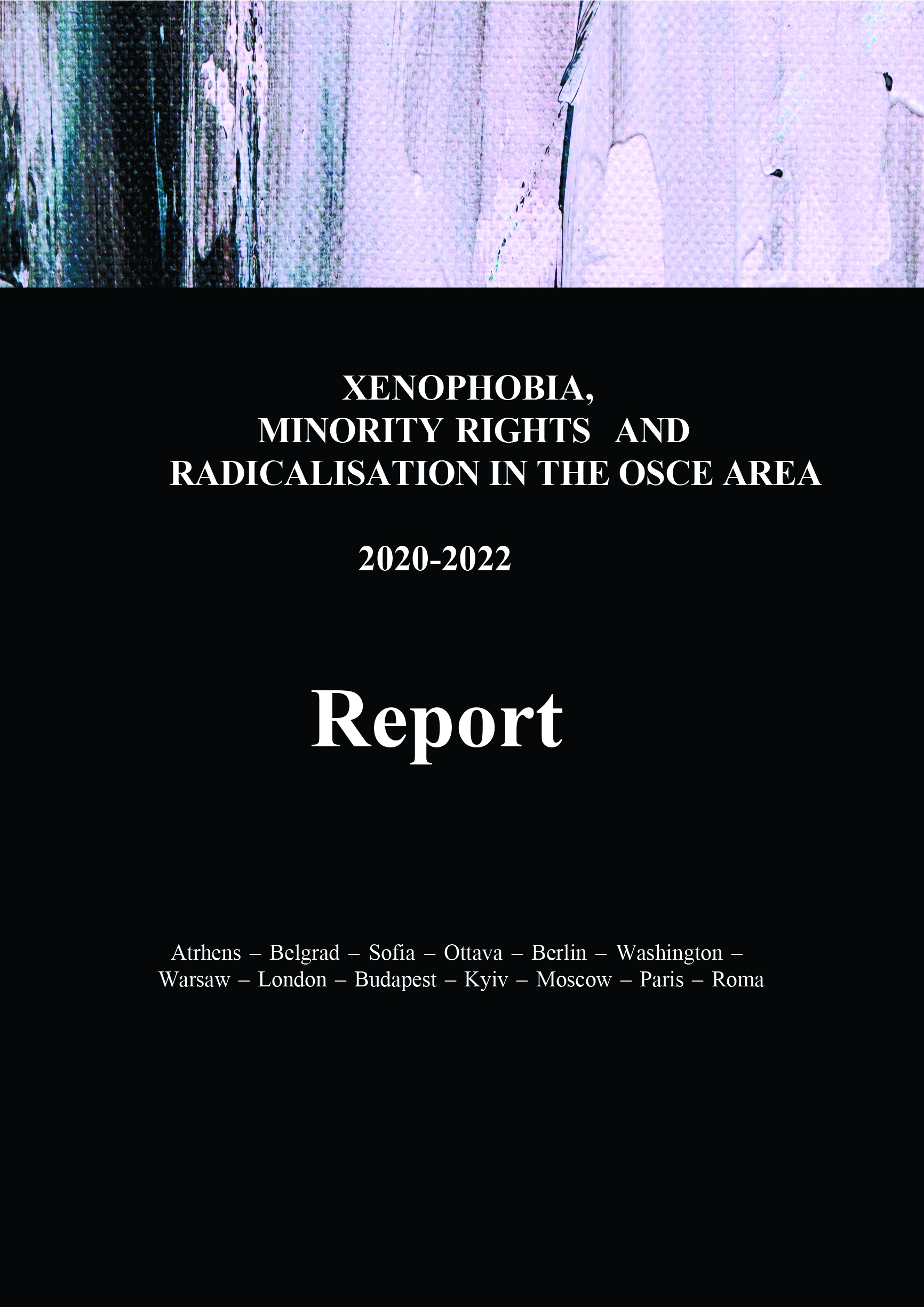
The European Center of Democracy Development offers yet another analytical report by an international team of leading experts on minority rights and manifestations of hatred, this time from 2020-22. The study covers 13 OSCE countries, including the United States and Canada. Of course, this set of monitoring countries does not cover all states that are members of this international organisation, but it allows us to trace general trends in lawmaking, law enforcement practice, and other areas of government and public life that affects the situation with extremism. The paper analyses the factors influencing the formation of public demand for radicalism, manifestations of xenophobia and racism, provides statistics on hate crimes, and analyses the activities of radical and extremist organisations. The analysis is based on the examples of the UK, Germany, Greece, Hungary, Italy, Bulgaria, Serbia, Poland, and France, as well as the USA, Canada, Russia, and Ukraine.

XENOPHOBIA, MINORITY RIGHTS AND RADICALISATION IN THE OSCE AREA, 2020-2022 (PDF, 2,17 MB)

© 2017 Civic Nation